Comprehensive Rules
Type a keyword. We filter Bushiroad's official English Comprehensive Rules as you type. The wording below is official. We did not rewrite it.
Palworld Official Card Game Comprehensive Rules ver. 1.00. Last update: July 30, 2026. Official PDF · Bushiroad Rule / Q&A.
Players often say Pal slot. Official rules call the play area the base. Search Pal slot to jump to those sections.
575 official rules · ver. 1.00
1. Overview of the Game
1.1Number of Players
1.1.1
This game is played by two players. These comprehensive rules do not apply to games played by any number of players other than two.
1.2Winning and Losing
1.2.1
If any player loses, then the game ends immediately. If you do not lose and your opponent does, then you win the game.
1.2.1.1
If a player’s life (3.2) is 0 or below, then he or she fulfills a losing condition (11.3.1).
1.2.1.2
If a player has no cards in their deck (4.5), then he or she fulfills a losing condition (11.3.2).
1.2.2
If all players lose simultaneously, then the game ends in a draw.
1.2.3
Any player may declare their concession at any time. The player who declared their concession immediately loses without proceeding to the check timing (10.5.1), and the game ends.
1.2.3.1
No effects can interfere with conceding. No effects can force a player to concede, and no effects can replace losing the game with a concession.
1.2.4
There are cards with effects that have a player win or lose the game. In these cases, that player wins or loses while resolving the effect without proceeding to the check timing (10.5.1), and the game ends.
1.3Golden Rules of the Game
1.3.1
If the comprehensive rules and the text of a card contradict with each other, then the text takes precedence.
1.3.2
If anything attempts to make a player do something he or she cannot perform, then nothing happens. If anything attempts to make a player do something he or she can only partially perform, then the player only performs the part that he or she can.
1.3.2.1
If anything attempts to turn a game state into a state that it is already in, then it does not become the state again, and that action never happens.
1.3.2.2
If there is any attempt to perform a certain action zero or a negative number of times, then nothing happens. No reverse action will take place even if it is a negative number of times. Likewise, if the number used as the basis for performing an action is zero, that action is not performed.
1.3.2.2.1
If an action other than addition or subtraction must be performed using a negative value as its basis, treat that value as 0 when performing that action.
1.3.2.3
If multiple effects require a player to perform a certain action, and it is impossible to satisfy all of the requirements, the player must choose and perform the action that satisfies as many of the requirements as possible.
1.3.2.4
Any numerical values associated with players or cards can be 0 or negative, unless any upper or lower limits are specified.
1.3.3
If an effect from a card attempts to do something, and at the same time an effect from a card restricts the action from taking place, then the effect that restricts the action takes precedence.
1.3.4
If more than one player is required to make a decision at the same time, the turn player makes the choice first. The non-turn player will make their choice after knowing the decision made by the turn player.
1.3.4.1
If an effect applies to both players and requires the execution of a series of multiple actions, any actions that do not involve choices are performed simultaneously, while actions that involve choices are performed starting with the turn player.
1.3.4.2
If more than one player is to make a choice of cards in a hidden zone at the same time, the turn player first chooses the required number of cards without checking their information, followed by the non-turn player choosing the required number of cards. If the chosen cards are to be revealed, it is done after both players have made their choices.
1.3.5
If anything asks a player to choose a number, then you must choose zero or a positive integer, if not specified. You cannot choose any fractions or negative numbers.
1.3.5.1
If a number is specified for the upper limit in a form such as “up to X”, unless a number is specified for the lower limit, you can choose zero.
2. Card Information
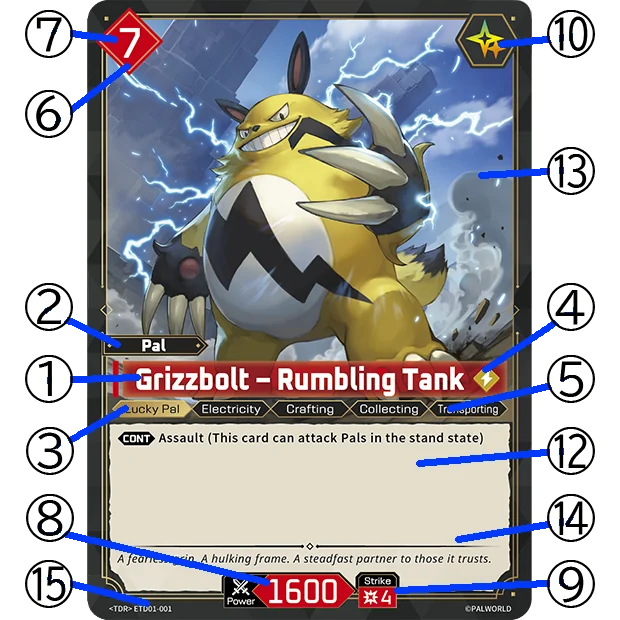
Pal
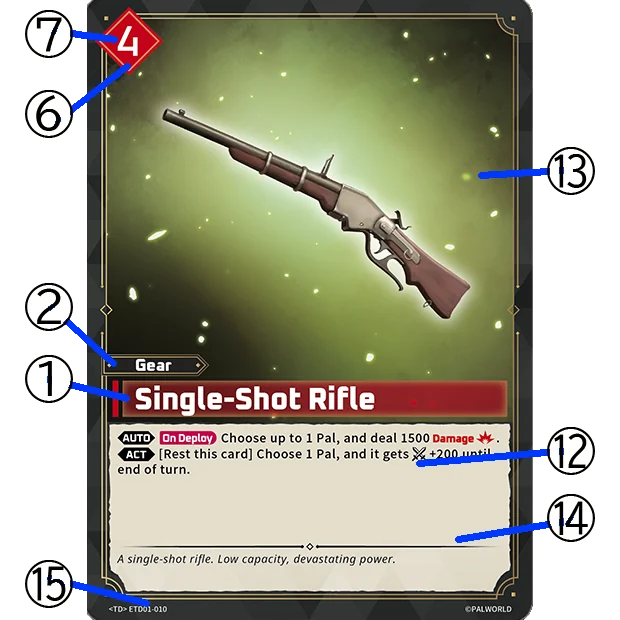
Gear
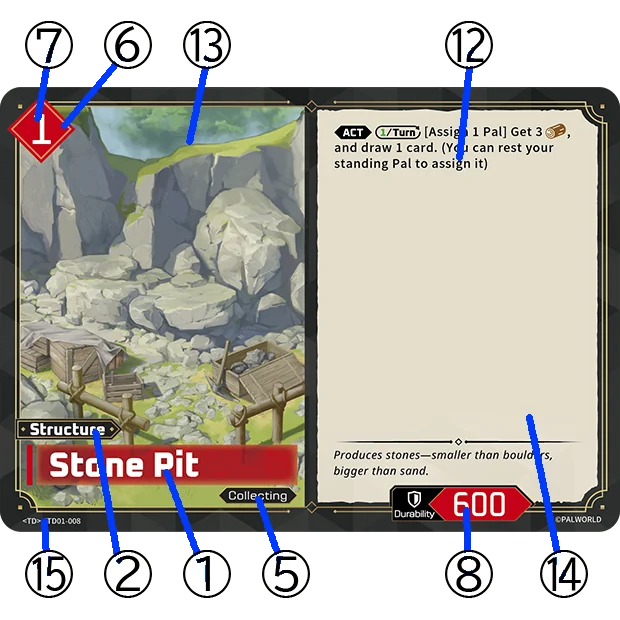
Structure
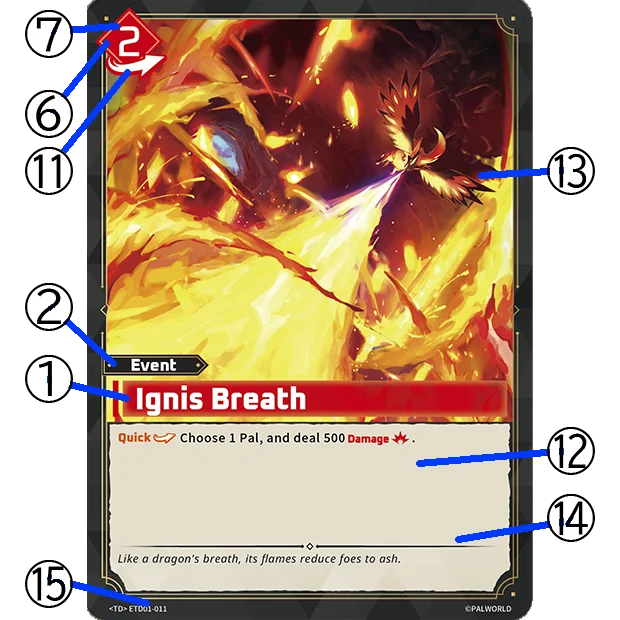
Event
- 1. Name
- 2. Card Type
- 3. Type
- 4. Element
- 5. Work Suitability
- 6. Color
- 7. Cost
- 8. Power
- 9. Strike
- 10. Lucky Icon
- 11. Quick Icon
- 12. Card text
- 13. Art
- 14. Flavor
- 15. Collection Data
2.1Name
2.1.1
The inherent name to identify a card.
2.1.2
Card names may be referenced during deck construction (6.1.1.2).
2.1.3
Card names may be separated into main name and sub name.
2.1.3.1
If a card name has an em dash (–) and a space before and after it, the text before it is the main name, and the text after it is the sub name.
2.1.3.2
If a card name does not match the above, that card does not have a main name or a sub name.
2.1.4
In text, the card’s name itself or a name included as part of the card’s name such as the main name, may be expressed as 《 (name)》, depending on context.
2.1.5
A card name may be added to a card by a card effect or other means. In such a case, that card possesses both its printed card name and the added card name simultaneously.
2.2Card Type
2.2.1
The information about the type of a card.
2.2.2
Cards can have five different types: Pal, Structure, Gear, Event, and Soul.
2.2.2.1
Cards with the “Pal” card type refer to creatures that you can deploy to assist yourself or attack your opponent.
2.2.2.1.1
Cards with the “Pal” card type have their type printed as “Pal”.
2.2.2.1.2
Cards with the “Pal” card type and the “Lucky” (2.3.1.2) subtype are considered to have the card type “Pal” and also “Lucky Pal” simultaneously.
2.2.2.1.3
Cards with the “Pal” card type and the “Normal” (2.3.1.1) subtype are considered to have the card type “Pal” and also “Normal Pal” simultaneously.
2.2.2.2
Cards with the “structure” card type refer to cards you can deploy to your base to assist yourself or your Pals.
2.2.2.3
Cards with the “gear” card type refer to cards you can field to assist your Pals.
2.2.2.4
Cards with the “event” card type are single use cards that generate individual effects.
2.2.2.5
Cards with the “soul” card type refer to cards that are used when performing various actions during the game.
2.3Type
2.3.1
The information about the subtype that the card has.
2.3.1.1
If this field shows “normal Pal”, it means that the card’s subtype is “normal”.
2.3.1.2
If this field shows “lucky Pal”, it means that the card’s subtype is “lucky”.
2.4Element
2.4.1
The information about the element that the card has.
2.4.2
The elements are displayed with icons.  Neutral
  Fire
Fire  Water
Water  Grass
Grass  Electric
  Ground
  Ice
Ice  Dark
Dark  Dragon
Neutral Fire Water Grass Electric Ground Ice Dark Dragon2.4.2.1
Neutral element () means that the card possesses the "Neutral" element. It does not mean that the card has no element.
) means that the card possesses the "Neutral" element. It does not mean that the card has no element.2.5Work Suitability
2.5.1
This indicates the type of work that this card is suitable for.
2.5.2
If a card’s ability or effect contains a name enclosed in 「」 (corner brackets) or “” (double apostrophe), it indicates the work suitability corresponding to that name.
2.6Color
2.6.1
The color of a card.
2.6.2
The color of a card is either red, blue, green or purple.
2.6.2.1
The color of a card will be indicated by the background color of its cost (2.7).
2.6.3
Some cards are shown as colorless. This means that they have no colors assigned to them and does not mean that they have colorless as their color.
2.7Cost
2.7.1
The cost required to play a card (10.6.2.3).
2.7.2
If text contains a number enclosed in ◇, it refers to either a card’s cost or a value used to modify a card’s cost, depending on the context.
2.8Power
2.8.1
This value indicates the damage this Pal deals to other Pals and structures, and whether it can remain on the base after receiving damage from other sources.
2.8.2
Power may be represented by the  icon within the text.
icon within the text.2.8.3
If the card type is “structure”, the power will be referred to as “durability”.
2.8.3.1
Durability may be represented by the  icon within the text.
icon within the text.2.9Strike
2.9.1
This value indicates the damage this Pal deals to a player.
2.9.1.1
Strike may be represented by the  icon within the text.
icon within the text.2.10Lucky Icon
2.10.1
This icon is referenced to determine damage dealt to a player.
2.11Quick Icon
2.11.1
This icon indicates that the card may be played in specific timings, or the ability may be played in specific timings..
2.12Card Text
2.12.1
The information about a card’s inherent abilities.
2.12.2
Some cards have text in ( ) (brackets) to indicate an explanation of an ability. This is called reminder text. Reminder text is part of the text, but as it is only for explanatory purposes, it does not affect the game.
2.13Art
2.13.1
The descriptive image of this card.
2.13.2
Art has no meaning in terms of rules.
2.14Flavor
2.14.1
The descriptive text of this card.
2.14.2
The flavor has no meaning in terms of rules.
2.15Collection Data
2.15.1
The card’s collection number, artist’s name, copyright, and other contents of the card with no direct relation to game that have not been mentioned thus far are collectively called the “collection data”.
2.15.2
The collection data is not part of the information of this card and generally has no meaning in terms of rules.
2.16Notation of Information
2.16.1
If a card’s ability or effect refers to a card by specifying certain information of the card, it refers to any card that has the information specified. For example, “gear or red structure” refers to a gear card or a red structure card and “ or less structure” refers to structure cards with a cost of 6 or less.
or less structure” refers to structure cards with a cost of 6 or less.3. Information Associated to Players
3.1Owner and Master
3.1.1
The owner is the player who owns the card. The owner of a card is the player who had it in their deck at the beginning of the game. At the end of each game, each player retrieves each card that he or she owns.
3.1.2
The master is the player who is currently using a card, ability, or effects. The master of a card in a zone is the player whom the zone belongs to.
3.1.2.1
The master of a continuous ability is the master of the card that has that ability, or the master of an effect that created that ability.
3.1.2.2
The master of an activated ability is the player who played it.
3.1.2.3
The master of an automatic ability is the master of the card that has that ability, or the master of an effect that created that ability.
3.1.2.4
The master of an effect is the master of the ability that generated that effect.
3.1.2.4.1
If an effect instructs for any actions to be performed without specifying a player, the master of that effect carries out those instructions.
3.2Life and Damage Taken
3.2.1
Each player has a numerical information called life.
3.2.1.1
There is no upper limit to life. During the game, a player's life can exceed the initial value by gaining additional life.
3.2.1.2
While there is no lower limit to life, if referencing values lower than 0 life, that value is referenced as 0.
3.2.1.3
Each player’s life count is public information; both players can always check each other’s life value.
3.2.2
Each player has numerical information called damage taken.
3.2.2.1
If a player receives damage (5.14.2) during the game, the value of damage taken increases.
3.3Resource
3.3.1
Each player has resource information.
3.3.1.1
The resource information consists of the resource name and the number of each resource.
3.3.1.2
Each player may hold multiple resources.
3.3.1.2.1
In the current game, each player may hold the following resources. ⬥ Material (may also be represented by  ) ⬥ Ingredient (may also be represented by
  )
)
) ⬥ Ingredient (may also be represented by )3.3.2
Resources are managed according to the resource names.
3.3.2.1
If a value refers to a resource name, it refers to the number of that particular resource you own.
3.3.3
The number of resources owned has to be 0 or more.
3.3.3.1
If the number of resources owned falls below 0, it becomes 0 instead.
3.3.3.2
If you are required to consume a specific resource (5.13) and you own fewer than the required number for that resource, the consumption cannot be performed.
3.3.4
During the game, each player’s resources are public information, and both players can confirm each other’s resource values at any time.
4. Zones
4.1Zones Basics
4.1.1
Each player has their own individual zone unless otherwise specified.
4.1.2
There are zones where all players may see the information of the cards in that zone, and zones where they may not. Zones in which information of the cards in that zone may be seen are “public zones”, and zones in which either or all players may not are called “hidden zones”.
4.1.2.1
When a card is placed in a public zone, it is placed in the public state (4.2.2). When a card is placed in a hidden zone, it is placed in the hidden state (4.2.3).
4.1.2.2
All players may check the number of cards in any zone at any time, regardless of whether the zone is public or hidden.
4.1.3
There are zones where the order cards are placed in the zone is controlled. If the order is controlled, the order the cards are stacked on each other is controlled. Unless otherwise specified, players cannot change the order of cards in a zone where the order is controlled.
4.1.4
When a card moves from a base to a non-base area, unless otherwise specified, it is considered as a new card in the new zone. Effects that applied in the previous zone do not continue to apply.
4.1.5
When multiple cards are placed in a zone at the same time, unless otherwise specified, the order they are placed in the new zone is decided by the owner of that zone.
4.1.5.1
When multiple cards are placed from a public zone into a hidden zone at the same time, and the master of those cards can determine the order those cards are placed, no player other than the master may know the order those cards are placed.
4.1.6
If a card belonging to a player is instructed to move to a zone that is not specified, it moves to the zone belonging to that card’s master, unless otherwise specified.
4.2Zone Visibility State
4.2.1
Cards in zones have either the public state or hidden state.
4.2.2
All players may see the information of cards in the public state.
4.2.3
Some or all players may not see the information of cards in the hidden state.
4.3Card Placement State
4.3.1
It is possible for the card placement state to be specified in some zones. The placement state is the orientation state of the card.
4.3.2
The orientation state can either be the “stand state” or the “rest state”. Cards can only have one of the two orientation states, and cannot be in both or neither of the states.
4.3.2.1
Cards in the stand state are placed with their text being vertically upright from its master’s viewpoint.
4.3.2.2
Cards in the rest state are placed with their text being horizontally from its master’s viewpoint.
4.3.2.3
When a card is placed in a zone where it is possible for the placement state to be specified, unless otherwise specified, it is placed in the stand state.
4.4Base
4.4.1
Base is the area where Pals, structures and gears are deployed and used.
4.4.2
The base is a public zone, the cards in this zone have directions as placement states. The order of the cards in the base is not fixed.
4.4.3
If a rule, ability or effect refers to a “Pal” (including “Lucky Pal” or “Normal Pal”), “Structure” or “Gear” without specifying a zone, it refers to a card of that type in the base.
4.4.4
Each Pal or structure at the base has numerical information called “damage taken”.
4.4.5
Each player has a numerical information called maximum number of Pals.
4.4.5.1
If the number of Pals played exceeds the Pal limit, the extra Pals are sent to the graveyard by rule action (11.5).
4.4.5.2
The Pal limit at the start of the game is 5.
4.5Deck Zone
4.5.1
The zone you put your deck in at the beginning of a game.
4.5.2
The deck zone is a hidden zone, and the order of the cards is controlled. Players can only change the order of the cards in the deck, or check the information of those cards, if an effect or rule instructs them to.
4.6Hand
4.6.1
The zone where each player places their unused cards without letting the opponent see them.
4.6.2
The hand is a hidden zone, but you can see information about the cards in your hand. You may not see information about cards in your opponent’s hand. The order of the cards in the hand is not controlled.
4.6.3
“(number) cards from the cards in your hand” is written as “(number) cards from your hand” in card text.
4.7Graveyard
4.7.1
The zone where each player places cards that have been used.
4.7.2
The graveyard is a public zone. Cards in this zone are stacked face up, and the information of cards are open to all players. The order of the cards in the graveyard is not controlled.
4.8Soul Deck
4.8.1
The area where you place the soul cards you prepared at the beginning of the game.
4.8.2
While the soul deck is a public zone, it is not necessary to place the cards face up. The order of cards in this zone is not tracked.
4.9Soul Area
4.9.1
The area where your souls are placed.
4.9.2
The soul area is a public zone. The cards in this area have orientation. The order of cards in this zone is not tracked.
4.10Exile Zone
4.10.1
The zone where cards removed from the game are placed.
4.10.2
The exile zone is a public zone where the order of the banished cards is not controlled.
4.11Resolution Zone
4.11.1
The zone where cards are put temporarily while resolving ability effects as the game progresses. There is only 1 resolution zone, shared and used by both players.
4.11.2
The resolution zone is a public zone and the order of the cards are controlled.
5. Specific Actions
5.1Overview
5.1.1
Specific actions are states or instructions of actions that have a special meaning when playing this game.
5.2Stand/Rest
5.2.1
When instructed to “stand” or “rest” a card, change the orientation of the specified card to the stand state or rest state in accordance with the instruction.
5.3Specific States
5.3.1
During a game, there may be a state with a specific name that all players reference simultaneously. This is called a “specific state”.
5.3.1.1
The current list of specific states in rules is as below. ⬥ Night
5.3.2
“It becomes (specific state)” means the game enters that specific state.
5.3.3
“It is (specific state)” means the game is currently in the specific state.
5.3.4
“If it is (specific state)” means the condition is met if the game is currently in the specific state.
5.4Place
5.4.1
When instructed to “place” a card into a specified zone, move that card to that zone.
5.5Exile
5.5.1
When instructed to “exile” a card, place the card in the exile zone.
5.6Shuffle
5.6.1
When instructed to “shuffle” the deck, the player who owns the deck randomly changes the order of the cards in that deck.
5.6.1.1
When instructed to shuffle a deck that has 0 cards or 1 card, the order of the cards in that deck is not changed, but the cut is considered to have been performed.
5.7Drawing Cards
5.7.1
When instructed to “draw 1” card, the specified player moves the top card of the deck to the specified player’s hand.
5.7.2
When instructed to “draw (number)” cards, the specified player repeats the action to draw 1 card (number) times.
5.7.3
When instructed to “draw up to (number)” cards, the specified player does the following.
5.7.3.1
If (number) is less than 0, nothing is done and this resolution ends.
5.7.3.2
The specified player can end the performing of this instruction.
5.7.3.3
The specified player draws 1 card.
5.7.3.4
If 5.7.3.3 has been performed (number) of times, this action ends. Otherwise, return to 5.7.3.1.
5.8Look at Cards from the Top of the Deck
5.8.1
When instructed to “look at the top (number) cards of the deck”, the specified player can check the information of the top (number) cards of that deck.
5.8.2
When instructed to “look at up to (number) cards from the top of the deck”, perform the following steps.
5.8.2.1
If (number) is 0 or less, nothing is done and this action ends.
5.8.2.2
Specify 1 as the number of cards.
5.8.2.3
The specified player can end the performing of this instruction.
5.8.2.4
The specified player can check the information of the card that is part of the specified number of cards from the top of the deck.
5.8.2.5
If the number of times 5.8.2.4 has been performed for this instruction has reached (number) times, the performance of this instruction ends. If it has not, increase the number of times performed by 1 and return to 5.8.2.3.
5.9Look at the Deck and Choose
5.9.1
If a player is instructed to “look and choose” a specific card from a deck or a specified range of cards within a deck, that player looks at the cards in the specified range, chooses the specified card(s) and separates them from the rest of the deck.
5.9.1.1
If a card is specified with conditions other than the number of cards, reveal it to all players after selection to confirm it meets the conditions.
5.9.1.2
If a card is specified with conditions other than the number of cards and there is no guarantee that the card is present in the specified range, even if it is, it may be treated as if it is not present intentionally.
5.9.1.3
If the condition is only the number of cards, choose all cards in the specified range if there are fewer than the required number. Otherwise, choose the required number of cards from the specified range. There cannot be no selections made in any case.
5.10Discard
5.10.1
When instructed to “discard” a card, move the card to that owner’s graveyard.
5.10.2
When instructed to “discard” a card without specifying the zone, discard from the player’s hand.
5.11Exchange
5.11.1
When instructed to “exchange” a card with another card, move the former card to the latter card’s zone and the latter card to the former’s card zone simultaneously.
5.11.2
If either of the cards is unable to move to the other’s zone at the point of performing the instruction to exchange for any reason, that instruction is not performed.
5.12Soul Cost Indication
5.12.1
Numbers with shapes (e.g.  ) from the card text indicates the soul cost or change in soul cost of that card.
) from the card text indicates the soul cost or change in soul cost of that card.5.12.1.1
If the soul cost is used to reference a card’s information, it refers to that card’s cost (2.7).
5.12.1.2
If the soul cost value is indicated on its own with a circled number as part of the activated ability (10.4.1), it refers to the value of the soul cost required (10.4.3). E.g.: “ [②] Draw 1 card" means playing an activated ability by paying 2 souls as the cost.
[②] Draw 1 card" means playing an activated ability by paying 2 souls as the cost.5.13Consume
5.13.1
When instructed to “consume” a specified amount of a specific resource (3.3), that player reduces the specific resource they own by the specified amount.
5.14(Dealing) Damage
5.14.1
If a Pal or structure at the base is instructed to take “(number) damage” or “is dealt (number) damage”, increase the amount of damage taken by that Pal or structure by (number).
5.14.2
If a player is instructed to take “(number) damage” or “is dealt (number) damage”, increase the amount of damage taken (3.2.2) by that player by (number).
5.14.3
Damage may be represented by the  icon within the text.
icon within the text.5.15Deploy
5.15.1
“To deploy” is a specific action to move a Pal, structure, or gear from anywhere that is not a base to any base.
5.15.2
When instructed to “deploy” a Pal, structure or gear card, move it to the base.
5.15.2.1
If the instruction does not specify which player’s base the card will be deployed to, it is deployed in the base of the player who is the master of the effect.
5.16Butcher
5.16.1
When a player is instructed to “butcher” a Pal and that player is the Pal’s master, move the Pal to the player’s graveyard.
5.16.2
When a player is instructed to “butcher a Pal” without specifying a particular Pal, that player butchers the specified number of pals that meet the conditions stated, out of the Pals he or she owns.
5.17Assign
5.17.1
If a Pal is “assigned” to a structure, perform the following.
5.17.1.1
If the Pal is in rest state, it cannot be assigned.
5.17.1.2
Put that Pal in rest state. This causes the Pal to be “assigned” to the structure and the structure to have the Pal “assigned” to it.
5.17.2
When instructed to “assign a Pal”, without specifying a particular Pal, select a Pal in stand state you own that meets the specified conditions, and assign it.
5.17.3
If a structure’s ability or effect instructs you to assign a Pal without specifying a particular structure, assign it to that structure.
5.18Attack Failure
5.18.1
If there is an instruction to “nullify the attack” while there is an attacking Pal (9.3.2.1), after resolving the effect that caused that instruction, move to the end of battle step (9.7) immediately.
5.19Declaring (a card name, etc)
5.19.1
When "declaring" a card name, main name, or sub-name of any card during a game, a player declares a card name, main name, or sub-name of any existing card or card that exists in the game.
5.20Same Name / Different Card Name
5.20.1
A card having the "same name" as another card means that both cards possess a common card name.
5.20.1.1
If any card has multiple card names, they are cards with the same name if any one of those names is common to each other.
5.20.2
A card having a "different card name" from another card means that those respective cards do not have the same name.
5.21(An Automatic Ability) Activates [X] Times
5.21.1
If an effect stating an automatic ability "activates (number) times" is applied to that automatic ability, when the trigger condition of that automatic ability is met, the automatic ability enters the pending state (number) times instead of entering the pending state once.
5.21.2
If multiple such processes are applied to a single automatic ability, the master of that automatic ability chooses and applies only one of those processes.
6. Setting Up the Game
6.1Preparing the Decks
6.1.1
Each player prepares a main deck with their own cards before the game.
6.1.1.1
The main deck must be constructed of exactly 50 cards.
6.1.1.2
The main deck must have 4 or less cards with the same card name between them.
6.1.1.3
The main deck may include up to a total of 8 cards with the lucky Pal icon(2.9).
6.1.2
Each player prepares the upper limit number of soul cards allowed.
6.1.2.1
The upper limit of each player’s souls at the beginning of the game is 10.
6.1.3
Continuous abilities regarding deck construction are applied as replacement effects that change the deck construction rules above. Those abilities are inactive ( 10.3.2) after the game starts.
6.2Preparing for the Game
6.2.1
Before the start of a game, players perform the following steps.
6.2.1.1
Present the main deck you will use for this game to your opponent.
6.2.1.2
Each player puts their main deck in their deck zone, and shuffles it.
6.2.1.3
Randomly determine a player, and that player chooses which player goes first.
6.2.1.4
Each player puts all of their soul cards into the soul deck area.
6.2.1.5
The player going second puts 1 card from their soul deck into their soul area.
6.2.1.6
Each player draws 5 cards from their deck, which forms the initial hand.
6.2.1.7
Starting from the player going first, each player may declare if they are redrawing their hand. If they do, that player returns all of the cards from their hand to their deck, shuffles it, and then draws 5 cards from the top of their deck for their hand.
6.2.1.7.1
Each player may only declare and perform this action once per game.
6.2.1.8
Each player sets their life to 10.
6.2.1.9
Each player sets their damage (3.2.2) to 0.
6.2.1.10
Each player sets their resources (3.3) to 0.
6.2.1.11
The player going first becomes the active player, and the game begins.
7. Game Progression
7.1Overview
7.1.1
The game progresses by repeating steps known as “turns”. During a turn, one player is the turn player, while the other is the non-turn player.
7.1.2
The turn player performs each of the phases from stand phase (7.2) to end phase (7.6) in the order shown.
7.2Stand Phase
7.2.1
The turn player stands all of the cards in their base and soul area.
7.2.2
Trigger conditions “at the beginning of turn” and “at the beginning of stand phase” are fulfilled. Also, if this is the first turn of the game, trigger condition “at the beginning of the game” is fulfilled.
7.2.3
A check timing occurs. After all the processes for that check timing have been completed, proceed to draw phase.
7.3Draw Phase
7.3.1
The player who goes first skips the draw phase, and proceeds to the soul phase.
7.3.2
Trigger condition “at the beginning of draw phase” is fulfilled, and a check timing occurs.
7.3.3
The turn player draws a card.
7.3.4
A check timing occurs. After all the processes for that check timing have been completed, proceed to soul phase.
7.4Soul Phase
7.4.1
Trigger condition “at the beginning of soul phase” is fulfilled, and a check timing occurs.
7.4.2
The turn player adds the number of soul cards to increase specified by the game from their soul deck to their soul area.
7.4.2.1
The number of souls to increase that is set at the beginning of a game is 2.
7.4.2.2
If the number of cards in your soul deck is less than the number of souls to increase, move all of the cards from your soul deck into the soul area.
7.4.3
A check timing occurs. After all the processes for that check timing have been completed, proceed to the main phase.
7.5Main Phase
7.5.1
Trigger condition “at the beginning of main phase” is fulfilled, and a check timing occurs.
7.5.2
The turn player gets a play timing. During this play timing, the turn player can do any of the actions stated in “8. Main Phase Processes”.
7.5.2.1
In this play timing, if the turn player is the master of a Pal that has to “attack as many times as possible”, and that Pal is able to perform an attack (9.2.2), the turn player cannot choose to do nothing to end this play timing.
7.5.3
If the turn player declares to do nothing else, proceed to the end phase.
7.6End Phase
7.6.1
Trigger condition “at the end of turn”, and automatic abilities with this trigger condition that have not been fulfilled this turn are fulfilled.
7.6.2
A check timing occurs.
7.6.3
The damage of all Pals and structures in all bases becomes 0.
7.6.4
All effects that have specified duration of “until end of turn” or “during turn” are invalidated.
7.6.5
At this point, if there are no automatic abilities and rule action to resolve during the check timing as stipulated in 7.6.2, and there are no “at the end of turn” trigger conditions or any other trigger conditions of automatic abilities that have not yet been fulfilled, the opponent of the current turn player becomes the turn player, and play proceeds to the next turn. Otherwise, return to the beginning of the end phase again.
8. Main Phase Processes
8.1Overview
8.1.1
This section provides further details about the actions the turn player may perform during the play timing of their main phase each turn.
8.1.2
The turn player may perform any of these actions any number of times in any order.
8.2Playing Cards
8.2.1
The turn player may choose a card from their hand, and play it (10.6.2).
8.3Playing Activated Abilities
8.3.1
The turn player may choose an active activated ability (10.3) from their cards, and play it (10.6.2).
8.4Start a Battle
8.4.1
If the turn player is the master of a Pal that is able to perform an attack (9.2.2), the turn player may declare to start a battle, and proceed to the attack step (9.3).
8.5Pay Souls to Draw a Card
8.5.1
The turn player may pay 3 souls (10.4.3) to draw 1 card.
8.5.2
This action may only be performed once per turn.
9. Battle
9.1Overview
9.1.1
The turn player may declare to start a battle during the main phase, and progress from attack declaration step (9.3) to end of battle step (9.7) in that order.
9.2Suitable Pal and Target for Battle
9.2.1
To start a battle, a Pal that is able to attack and a battle target that that Pal is able to attack are needed.
9.2.2
A suitable Pal that is able to attack is determined by the following conditions.
9.2.2.1
The turn player is the master of that Pal, and that Pal must be in the standing state.
9.2.2.2
That Pal must not be in a state where it cannot battle due to an effect.
9.2.2.3
Even if the Pal was deployed in your base this turn, it may perform an attack.
9.2.3
Targets that can be chosen for the attack are the non-turn player, or 1 of the structures or Pals in the resting state that the non-turn player is the master of.
9.2.4
Based on the conditions above, if 1 Pal that is able to attack and 1 attack target can be chosen, it is suitable for the turn player to start a battle.
9.2.4.1
Even if 1 Pal and 1 attack target is chosen, if that Pal is unable to attack that target due to an effect, that combination is not a suitable combination to start a battle.
9.3Attack Declaration Step
9.3.1
The turn player chooses a Pal that is able to attack (9.2.2), and a target that that Pal is able to attack (9.2.3).
9.3.1.1
If either of the 2 are not suitable to be chosen for any reason, the battle is cancelled, and the game reverts to the point before the declaration to start a battle.
9.3.2
Rest the chosen Pal. This Pal is now considered to have “attacked”, and the attack target to have “been attacked”.
9.3.2.1
From here onwards, this Pal is regarded as the “attacking” Pal during this battle.
9.3.3
A check timing occurs. After all the processes for that check timing have been completed, proceed to the block declaration step.
9.4Block Declaration Step
9.4.1
Trigger condition “at the beginning of block declaration step” is fulfilled, and a check timing occurs.
9.4.2
The non-turn player may choose 1 Pal in the standing state that is not an existing attack target that they are the master of, and is not restricted from blocking an attacking Pal due to an effect.
9.4.2.1
If a Pal is chosen, rest that Pal, and the attack target of this attack becomes that Pal.
9.4.3
If the attack target is a Pal, during this battle, the attacking Pal and the attack target Pal both become each other’s “battle opponent”.
9.4.4
A check timing occurs. After all the processes for that check timing have been completed, proceed to the quick step.
9.5Quick Step
9.5.1
Trigger condition “at the beginning of quick step” is fulfilled, and a check timing occurs.
9.5.2
The non-turn player gets a play timing. During this play timing, the non-turn player can choose to play from their hand, an event card, or an activated ability that is active, that can be played during this step (12.2.1).
9.5.2.1
This can be performed any number of times in any order.
9.5.2.2
The turn player cannot activate abilities of cards during quick step.
9.5.3
A check timing occurs. After all the processes for that check timing have been completed, proceed to the damage step.
9.6Damage Step
9.6.1
Trigger condition “at the beginning of damage step” is fulfilled, and a check timing occurs.
9.6.2
If, for any reason, the attacking Pal or the attack target ceases to exist, proceed to 9.6.4.
9.6.3
Perform the following depending on the attack target.
9.6.3.1
If the attack target is a Pal, the attacking Pal and the attack target Pal both deal damage equal to their power value to each other.
9.6.3.1.1
At this point, if the Pal’s power is 0 or less, that Pal does not deal damage (1.3.2.2)
9.6.3.2
If the attack target is a structure, the attacking Pal deals damage equal to its power value to the attack target.
9.6.3.2.1
The structure does not deal damage to the attacking Pal.
9.6.3.3
If the attack target is a player, perform the following steps.
9.6.3.3.1
Confirm the attacking Pal’s strike. If the strike is 0 or less, nothing happens.
9.6.3.3.2
The attacking Pal deals damage ( 11.2) to the attack target player equal to its strike.
9.6.3.4
Damage that the Pal deals in 9.6.3.1 and 9.6.3.2 and damage that the attacking Pal deals to a player in 9.6.3.3.2 are referred to as battle damage.
9.6.4
A check timing occurs. After all the processes for that check timing have been completed, proceed to the end of battle step.
9.7End of Battle Step
9.7.1
Trigger condition “at the end of the battle”, and automatic abilities with this trigger condition that have not been fulfilled this battle is fulfilled.
9.7.2
A check timing occurs.
9.7.3
All effects that have specified duration of “until end of the battle” or “during this battle” are invalidated.
9.7.3.1
From here onwards, the “attacking Pal” stops being in the attacking state.
9.7.4
At this point, if there are no automatic abilities and rule action to resolve during the check timing as stipulated in 9.7.2, and there are no “at the end of the battle” trigger conditions or any other trigger conditions of automatic abilities that have not yet been fulfilled this battle, this battle ends, and returns to the play timing (10.5.4) of the main phase of the turn player. Otherwise, return to the beginning of the end of battle step again.
10. Play and Resolve Cards and Abilities
10.1Categories of Abilities
10.1.1
Abilities are divided into three categories: activated abilities, automatic abilities, and continuous abilities.
10.1.1.1
Activated abilities refer to abilities that can be performed by a player with a play timing by paying the cost.
10.1.1.1.1
On a card, activated abilities are written as “ [(Cost)] (Effect)”. Text enclosed by [] refers to the cost of playing that activated ability, followed by text that refers to the effect that occurs as a result of resolving that activated ability.
[(Cost)] (Effect)”. Text enclosed by [] refers to the cost of playing that activated ability, followed by text that refers to the effect that occurs as a result of resolving that activated ability.10.1.1.1.2
There are activated abilities that have 【Quick】(12.2) at the beginning of the ability, which can be played during the quick step (9.5.2).
10.1.1.2
Automatic abilities refer to abilities that are automatically played as a result of a designated situation that occurs during the game.
10.1.1.2.1
On a card, automatic abilities are written as “ When (Condition), (Effect)”, or “ At the beginning of (Phase or Step), (Effect)” or “At the end of (Phase or Step), (Effect)”. The situations specified by (Condition) and (Phase or Step) are known as “Trigger Condition”, and fulfilling a trigger condition is known as “triggering (that ability)”.
When (Condition), (Effect)”, or “ At the beginning of (Phase or Step), (Effect)” or “At the end of (Phase or Step), (Effect)”. The situations specified by (Condition) and (Phase or Step) are known as “Trigger Condition”, and fulfilling a trigger condition is known as “triggering (that ability)”.10.1.1.3
Continuous abilities refer to abilities which remain in effect for the specified duration that that ability is in effect.
10.1.1.3.1
On a card, continuous abilities are written as “ (Effect)”.
(Effect)”.10.2Categories of Effects
10.2.1
Effects are divided into three categories: “one-shot effects”, “continuous effects”, and “replacement effects”.
10.2.1.1
“One-shot effects” refer to effects that resolve by executing that action, and ending the effect thereafter. For example, effects generated by abilities such as “draw a card” or “put this card into the graveyard” are one-shot effects.
10.2.1.2
“Continuous effects” refer to effects that remain in effect for a specified duration (including “during this game”, for effects with no specified duration).
10.2.1.3
“Replacement effects” refer to effects that replace the execution of an existing situation during the game with the execution of another situation instead.
10.2.1.3.1
If an ability is written as “if (player) would do A, do B instead”, the effect generated by that ability is a replacement effect.
10.2.1.3.2
If an ability is written as “if (player) would do A, (player) may [Choice] instead”, the effect generated by that ability is an optional replacement effect.
10.3Active Abilities and Inactive Abilities
10.3.1
Some effects make an effect “active” or “inactive”. If this is the case, resolve the ability as follows.
10.3.2
If all or part of an effect becomes inactive under a specific condition, under said condition, that part exists as an ability, but no effects are generated. If that effect required a choice to be made, no choice is made.
10.3.3
If all or part of an effect becomes active under a specific condition, in the state where said condition is not fulfilled, that part is inactive.
10.3.4
Abilities with a zone specified are only active in the zone specified.
10.3.4.1
There are abilities that have the zone icon at the beginning of the ability. In this case, those abilities are active while they are in the zones specified by the zone icons.
10.3.4.1.1
Abilities with the  icon are active in the hand.
icon are active in the hand.10.3.5
Abilities of a card with a card type “Pal”, “Structure”, or “Gear” specified and do not have a zone specified are only active if that card is in the base.
10.4Cost and Paying Cost
10.4.1
Some activated or automatic abilities contain an action(s) enclosed within [] at the beginning of the text, which are known as the cost of that ability.
10.4.2
“Pay the cost” refers to “perform the action(s) stipulated in the cost”.
10.4.2.1
If there are multiple actions in the cost, execute the actions in order, starting with the action closest to the beginning of the text.
10.4.2.2
If the whole cost or part thereof cannot be paid, no part of the cost to play this ability is paid. You may not pay for only part(s) of the cost.
10.4.3
Among the costs, if the cost requires a specified number of souls to be paid, change the specified number of souls in your soul area from standing state to resting state.
10.5Check Timing and Play Timing
10.5.1
Check timing refers to the time when rule action occurs during the game or an automatic ability is played.
10.5.1.1
For check timing, all rule actions will be resolved first, and when there are no longer any rule actions to be resolved, automatic abilities with trigger conditions fulfilled can be played and resolved (10.5.3).
10.5.2
Play timing refers to the time when the specified player can perform an action. If a player is given a play timing, a check timing always occurs before an action can be chosen. After all rule actions and automatic abilities have been resolved for that check timing, that player will be given a play timing.
10.5.3
When a check timing occurs, the game advances in the order as follows.
10.5.3.1
All rule actions that must be resolved at this point are simultaneously resolved. If, as a result, there are new rule actions to be resolved, this step is repeated insofar as there are rule actions remaining to be resolved.
10.5.3.2
If there are automatic abilities in a standby condition that the turn player is a master of, the turn player chooses 1 ability from among them, plays and resolves it, and returns to 10.5.3.1.
10.5.3.3
If there are automatic abilities in a Standby Condition that the non-turn player is a master of, the non-turn player chooses 1 ability from among them, plays and resolves it, and returns to 10.5.3.1.
10.5.3.4
The check timing ends.
10.5.4
When a player gets a play timing, the game advances in the order as follows.
10.5.4.1
A check timing occurs. Resolve the check timing.
10.5.4.2
Only at this point does that player get a play timing. At this point, that player executes any action that is allowed, or chooses to do nothing. If that player executes an action, unless otherwise specified, that player gets another play timing after this play timing.
10.5.4.3
If the player that gets a play timing chooses to do nothing, the play timing ends, and the phase or step proceeds.
10.6Playing and Resolving
10.6.1
Activated abilities, automatic abilities, and cards in hand need to be played and resolved for the effect to occur. Continuous abilities are not played, as the effect is always in effect.
10.6.2
A player plays a card or an ability as follows.
10.6.2.1
The player designates an ability, or card in their hand to play, and puts it in the resolution zone.
10.6.2.1.1
If it is a card in a hidden zone, reveal it and put it in the resolution zone.
10.6.2.1.2
If it is an ability, put it as a pseudo card in the resolution zone.
10.6.2.2
If the card or ability requires the player to make any choices, they make that choice.
10.6.2.2.1
If the card or ability requires the player to make any choices and there is a list of choices that follow after that, they make that choice from the specified number of options when playing it. At that point, the options that were not chosen are regarded as not being in effect.
10.6.2.2.2
If the value of part of the card or ability is outlined as “X”, and the way to determine X is not outlined in that text, the value of that X is regarded as 1.
10.6.2.3
If there is a cost for the card to be played, the player determines the cost, and pays the cost in full.
10.6.2.3.1
If there are multiple ways to pay the cost, the way to pay the cost is determined at the point of paying the cost.
10.6.2.4
Resolution of the card or ability occurs.
10.6.2.4.1
If what is played is a card, and the card type is “Pal” or “structure” or “gear”, place that card in its master’s base.
10.6.2.4.2
If what is played is a card, and the card type is “event”, perform what is written in that text, and subsequently put that card into its owner’s graveyard.
10.6.2.4.3
If what is played is an activated ability or automatic ability, perform the effects outlined in that ability, and remove that ability from the resolution zone.
10.6.2.4.4
Even if the card that has the activated ability or automatic ability is no longer in its original zone for any reason, that ability will resolve.
10.6.3
If a card or ability states “choose”, during resolution, the player chooses the appropriate card(s) or player(s), et cetera, (henceforth referred to as “targets”) among the choices presented at the point where the instruction was given.
10.6.3.1
If the number of choices is specified, the player must choose as many targets as possible up to the specified number. If a player can make a choice, that player is not allowed to not make a choice.
10.6.3.1.1
If the number of choices is specified by “choose up to”, the player may choose any number of targets from 0 up to the specified number of choices.
10.6.3.1.2
If the number of choices is specified, but it is impossible to make that many choices, the player chooses as many targets as possible, and applies the relevant effects on those targets.
10.6.3.1.3
If the number of choices is specified, and no targets can be chosen, no target is chosen. All effects relating to that target are ignored.
10.6.3.1.4
If there is an instruction to execute the text enclosed in 〈〉 multiple times, and there is an action to choose something within those 〈〉, you can choose the same target for each of those executions.
10.6.3.1.5
If the targets are unrevealed cards in a hidden zone, and if the information of the card(s) is required to fulfill the condition(s) of the choice, it is not guaranteed that those cards in the hidden zone possess that information. Even if there are cards in that zone that fulfill the condition(s), the player is allowed to not choose those cards.
10.7Restriction on Number of Times
10.7.1
There are activated abilities and automatic abilities with  restriction on the number of times. These abilities are restricted in the number of times they can be played.
restriction on the number of times. These abilities are restricted in the number of times they can be played.10.7.2
If an activated ability has a restriction on the number of times, that ability cannot be played beyond that number of times of that restriction.
10.7.3
If an automatic ability has a limit on the number of times it can be played, at the time it enters the pending state and is to be played, the master of that ability can choose not to play it, cancel that instance of the pending state, and choose not to count it toward the play limit.
10.8Resolving Automatic Abilities
10.8.1
Automatic abilities refer to abilities that are played during the check timing that occurs as a result of fulfilling a specified trigger condition(s).
10.8.2
When any automatic ability’s trigger condition(s) is fulfilled, that automatic ability will enter the standby state.
10.8.2.1
When an automatic ability’s trigger condition(s) is fulfilled multiple times, that automatic ability enters the standby state an equal number of times.
10.8.3
At the stage when a check timing occurs, the player who wishes to play an automatic ability chooses 1 of the automatic abilities in a standby state that they are a master of, and plays it. After the played ability is resolved, 1 occurrence of that ability’s standby state is extinguished.
10.8.3.1
Players must play all automatic abilities in the standby state; players are not allowed to choose not to play any automatic abilities in the standby state. However, when an automatic ability that the player is a master of enters the standby state multiple times, the player can choose their order of resolution.
10.8.3.1.1
If the player can choose to play the automatic ability by paying an optional cost, the player can choose to not pay the cost, and not play that automatic ability.
10.8.3.2
If the chosen automatic ability in standby state cannot be played for any reason, 1 occurrence of that automatic ability’s standby state is extinguished.
10.8.3.2.1
If an automatic ability can be played upon paying a cost, and a player chooses not to pay the cost, and consequently, not play the ability, 1 occurrence of that automatic ability’s standby state is extinguished.
10.8.4
Some cards possess automatic abilities with trigger condition(s) that are fulfilled upon moving that card to another zone. This is known as “zone change trigger condition”.
10.8.4.1
Some automatic abilities with zone change trigger condition(s) require the information of the card that activated that ability. In that instance, look up the information as follows.
10.8.4.1.1
If it is an automatic ability that requires information from a card when the card is moved from a public zone to a hidden zone, or from a hidden zone to a public zone, use the information available when said card is/was in the public zone.
10.8.4.1.2
If it is an automatic ability that requires information from a card when the card is moved from the base to a zone other than the base, use the information available when said card was on the base.
10.8.4.1.3
If it is an automatic ability that requires information from a card when the card is moved from a public zone to another public zone (except as outlined in 10.8.4.1.2), use the information available in the zone after said card has moved.
10.8.4.2
If a card has the zone change trigger condition, and that card moves to a zone where that ability is active at the same time that another card moves to a zone that fulfills that zone change trigger condition, that trigger condition is considered to be fulfilled.
10.8.5
Some effects create automatic abilities which possess trigger conditions that are fulfilled at a later point in the game. An ability created in this manner is called a delayed triggered ability.
10.8.5.1
Delayed triggered abilities, unless otherwise specified, fulfill trigger condition(s) only 1 time.
10.8.6
Some automatic abilities possess trigger conditions that are fulfilled not when a specified event occurs, but when a specified condition is fulfilled (such as “when there are no cards in your hand”). This is known as “state trigger condition”.
10.8.6.1
When the state trigger condition is fulfilled, automatic abilities with state activation enter a standby state only 1 time. After this automatic ability is resolved, if that automatic ability’s trigger condition is fulfilled again, that ability enters the standby state again.
10.8.7
When an automatic ability in the standby state is played, even if the zone of the card that possessed that ability is changed, that automatic ability must still be played.
10.9Resolving One-Time Effects
10.9.1
When a one-time effect is required to be executed, the action that is instructed is executed 1 time.
10.10Resolving Continuous Effects
10.10.1
If a card’s information is required when any continuous effects that require said information are in effect, the continuous effect is applied on that information in the order as follows.
10.10.1.1
Information that is written on the card is the base value.
10.10.1.2
Next, effects that grant abilities, remove abilities, enable abilities, or disable abilities are applied.
10.10.1.3
Next, all continuous effects that do not change the value of the information are applied.
10.10.1.4
Next, all continuous effects that change the value of the information are applied.
10.10.1.5
If the order of application of Continuous Effect A and Continuous Effect B is not determined by 10.10.1.2-10.10.1.4, and the application of Effect A affects what Effect B is applied on or how it is applied, Effect B is an effect that is dependent on Effect A. An effect that is dependent on any other effect is always resolved after the effect it is dependent on is resolved
10.10.1.6
If the order of application of multiple continuous effects is not determined by 10.10.1.2-10.10.1.5, those continuous effects are applied in the order that they were generated.
10.10.1.6.1
If the source of activation of a continuous effect is a continuous ability, the time when the card possessing that ability is placed on its current zone is its fundamental order.
10.10.1.6.2
For all other abilities, the time when the ability is played is its fundamental order.
10.10.2
Continuous effects resulting from trigger conditions other than continuous abilities will not apply to cards that move from the base to a zone other than the base after that ability has been played.
10.10.3
If a continuous effect changes the information of a card in a specified zone, the change is applied on said card the instant it enters that zone.
10.10.3.1
If the trigger condition of an automatic ability is a card possessing specified information entering a specified zone, the information is referred to only after the continuous effect for that zone has been applied.
10.11Resolving Replacement Effects
10.11.1
When a replacement effect occurs, if there is a situation that would have occurred otherwise, it does not occur, and is replaced by another situation stated by the replacement effect.
10.11.1.1
In so doing, the original situation that would have resulted otherwise, does not occur at all due to the replacement effect.
10.11.2
If multiple replacement effects are generated simultaneously by the same situation, the player receiving the consequences of those effects makes the decision as to which effects are applied first.
10.11.2.1
If the consequence affects a card or an ability, its respective master makes the decision.
10.11.2.2
If the consequence affects an action during the game, the player that performs that action or the master of the card that applies that action makes the decision.
10.11.2.3
For the same situation, each replacement effect is applied a maximum of 1 time.
10.11.3
If the replacement effect is a choice-type replacement effect (“when …, (the player) may …. instead. If they do, do …), if that choice cannot be made, this replacement effect is not applied.
10.12Final Information
10.12.1
If an effect references a specified card’s information and/or state, and if the specified card is moved from that zone or a base to a zone other than the base while that effect is being performed, that effect references the information and/or state of the card as when that card was last in that zone.
10.13Source
10.13.1
Some abilities and effects require identifying where the source of the effect or damage is from.
10.13.2
The source of an ability refers to the card that has that ability, or, in the case of a delayed triggered ability, the card that has the ability that caused that delayed triggered ability to occur.
10.13.3
If an effect deals damage, unless otherwise specified, the source of damage is the card that possessed said ability with that effect, and if the damage is due to battle, the source of damage is the card that dealt that damage.
11. Rule Action
11.1General Rule Action
11.1.1
“Rule Action” is a collective term referring to a resolution automatically performed in accordance with the rules when a specified event has occurred or is occurring during the game.
11.1.2
Rule actions are classified as two types: interrupt type rule actions that suspend the game temporarily when specific situations occur, and check type rule actions that check if the conditions are fulfilled during check timing.
11.1.2.1
Rule actions classified as interrupt type rule actions are performed when a specified condition(s) is met during the game, suspending all actions being performed without exception, performing itself immediately.
11.1.2.2
If there are multiple masters of the card(s) or zone(s) related to those rule actions, the turn player performs all interrupt type rule actions that are related to their own cards or zones first, followed by the non-turn player.
11.1.2.3
Rule actions classified as check type rule actions are performed only when a specified condition(s) is fulfilled during a check timing. Even if the condition(s) is fulfilled during the resolution of another action, if that condition(s) is not fulfilled during the check timing, this rule action does not happen.
11.1.2.4
When multiple check type rule actions are to be performed simultaneously, all those rule actions are performed simultaneously.
11.2Player Damage Resolution
11.2.1
If any player’s damage taken (3.2.2) is 1 or greater, perform the following. This is an interrupt rule action.
11.2.1.1
If multiple players have taken 1 or more damage, perform the player damage resolution of the turn player first.
11.2.2
Perform the following for player damage resolution.
11.2.2.1
That player puts the top card of their deck into their graveyard.
11.2.2.2
If the card put into the graveyard from this action has a lucky Pal icon (2.10), proceed to 11.2.2.4.
11.2.2.3
If the number of cards put into the graveyard by this action during this damage resolution is equal to or greater than the damage taken by that player, or the number of cards in that deck is zero, reduce that player’s life by that amount of damage, then proceed to 11.2.2.4. Otherwise, return to 11.2.2.1.
11.2.2.4
Set the amount of damage taken by that player to 0, and this player damage resolution ends.
11.3Losing Verdict Resolution
11.3.1
If any player’s life is 0 or less, that player loses the game.
11.3.2
If any player’s number of cards in their deck becomes 0, that player loses the game.
11.3.3
Losing verdict resolution is a check type rule action.
11.4Lethal Damage Resolution
11.4.1
If any Pal or structure in any base takes greater than 0 damage, and it is equal to or greater than that Pal’s power or structure’s durability, put that Pal or structure into their owner’s graveyard.
11.4.2
Lethal damage resolution is a check type rule action.
11.5Overloaded Pals Resolution
11.5.1
If the number of a player’s Pals in a base exceeds the maximum number of Pals (4.4.5), perform the following resolution.
11.5.1.1
If the number of Pals placed in that base most recently exceeds the maximum Pal limit of that base's master, choose a number of Pals equal to the maximum Pal limit from among those Pals. Otherwise, choose all of those Pals.
11.5.1.2
From among the Pals in that base that were not placed in that base most recently, additionally choose a number of Pals equal to the value calculated by subtracting the number chosen in 11.5.1.1 from the maximum Pal limit of that base's master.
11.5.1.3
Put all Pals other than those chosen in 11.5.1.1 and 11.5.1.2 from that base into their owner’s graveyard at the same time.
11.5.1.4
That player must choose until it reaches the maximum number of Pals.
11.5.2
Overloaded Pals resolution is a check type rule action.
12. Keywords and Keyword Abilities
12.1Overview
12.1.1
Keywords are terms that are used to abbreviate abilities that perform specific processes. Abilities that are indicated by specific keywords are called keyword abilities.
12.2Quick
12.2.1
Quick is a keyword written in the text of cards and abilities that can be played during the Quick Step (9.5).
12.2.1.1
If an activated ability (10.1.1.1) has this keyword at the beginning of its text, that ability itself can be played during the Quick Step.
12.2.1.2
If an event card has this keyword at the beginning of its text, that event card can be played during the Quick Step.
12.2.2
"【Quick】" may be represented by a  icon.
icon.
icon.12.3On Deploy
12.3.1
On deploy is an automatic ability that triggers when the card is deployed (5.15).
12.3.2
“【On Deploy】(effect)” means “when this card is deployed, (effect)”.
12.3.2.1
【On Deploy】 may be represented by the  icon within the text.
icon within the text.12.4On Attack
12.4.1
On attack is an automatic ability that triggers when the card attacks (9.3.2).
12.4.2
“【On Attack】(effect)” means “when this card attacks, (effect)”.
12.4.2.1
【On Attack】 may be represented by the  icon within the text.
icon within the text.12.5On Assign
12.5.1
On assign is an automatic ability that triggers when the card is assigned to a structure (5.17).
12.5.2
“【On Assign】(effect)” means “when this card is assigned, (effect)”.
12.5.2.1
【On Assign】 may be represented by the  icon within the text.
icon within the text.12.6Brave
12.6.1
Brave is an automatic ability that triggers when the card attacks, and its effect increases its power.
12.6.2
“Brave (number)” means “【On Attack】, this card’s power increases by (number) until end of turn”.
12.7Serious
12.7.1
Serious is an automatic ability that triggers when the card is assigned to a structure, and its effect increases a Pal’s power.
12.7.2
“Serious (number)” means “【On Assign】 Choose 1 Pal, and its power increases by (number) until end of turn”.
12.8Interrupt
12.8.1
Interrupt is a quick activated ability that can nullify an attack.
12.8.2
Interrupt means “【Quick】 [①, discard this card] OR [Discard this card and 1 other card from hand] Nullify the opponent's attack”.
12.9Vigilance
12.9.1
Vigilance is an automatic ability that triggers when the turn ends, and its effect stands the card at the end of the turn.
12.9.2
“Vigilance” means “at the end of your turn, stand this card”.
12.10Taunt
12.10.1
Taunt is a continuous ability that forces the card to be chosen as the target of attacks.
12.10.2
“Taunt” means “the opponent must target this card if it can be targeted for an attack” (9.3.1).
12.10.2.1
If there are multiple cards with Taunt that can be chosen as an attack target, the player is obligated to choose one of them, regardless of the number of instances of Taunt each card possesses.
12.10.3
If a card with taunt cannot be chosen as the valid attack target, a different valid target may be chosen instead.
12.11Stealth
12.11.1
Stealth is a continuous ability that restricts the blocking of the card’s attacks.
12.11.2
“Stealth” means “this card cannot be blocked”.
12.12Retaliate
12.12.1
Retaliate is an automatic ability that triggers when the Pal is put into the graveyard during a battle, sending the opposing Pal to the graveyard as well.
12.12.2
“Retaliate” means “when this card is put into the graveyard, if this was a Pal that battled, put the opposing combat Pal into the graveyard”.
12.13Nocturnal
12.13.1
Nocturnal is a continuous ability that increases power while the specific state “night” is active.
12.13.2
“Nocturnal” means “if it is night, this card’s power increases by 300”.
12.14Breakthrough
12.14.1
Breakthrough is an automatic ability that triggers during combat when the opposing combat Pal is put into the graveyard, and its effect deals damage to the master of that Pal.
12.14.2
“Breakthrough” means “if the opposing combat Pal is put into the graveyard when this card is attacking, deal damage to the master of the opposing combat Pal equal to this card’s strike”.
12.15Assault
12.15.1
Assault is a continuous ability that allows a card to choose a Pal in the stand state as an attack target.
12.15.2
"Assault" means "This card can choose a Pal in the stand state as an attack target" (9.2.3).
13. Miscellaneous
13.1Infinite Loops
13.1.1
When performing a resolution, it is possible that some actions may be performed indefinitely, or a player is forced to perform an action indefinitely. This is known as an “infinite loop”, and the sequence of actions from the start of an infinite loop until it goes back to its original point are known as “loop actions”. In this instance, do as follows:
13.1.1.1
During that sequence, if both players are unable to stop that infinite loop, the game ends in a draw.
13.1.1.2
If either player is able to stop that infinite loop, the player(s) that can stop that infinite loop decides the number of times that infinite loop will be performed starting from the turn player. Then, that action is performed the lowest number of times chosen between the players.
13.1.1.2.1
If the game remains in the same state after performing the loop the specified number of times, that infinite loop cannot be performed again.
13.2Managing Souls Without Soul Cards
13.2.1
During a game, players may be permitted to manage their souls without using physical soul cards.
13.2.1.1
In casual matches, this is determined by the mutual agreement of both players. In events such as tournaments, whether this is permitted or not is determined by the regulations of that specific event.
13.2.2
When managing souls without soul cards, a player must track the total number of soul cards that would be placed there if soul cards were used, as well as the number of those soul cards that would be in the standing state.
13.2.3
If any process is applied to cards in the soul area during a game, that process is applied as if soul cards corresponding to the currently tracked soul values exist in the soul area, and the player continues to track the values modified by the results of that process.